The Satir Change Model
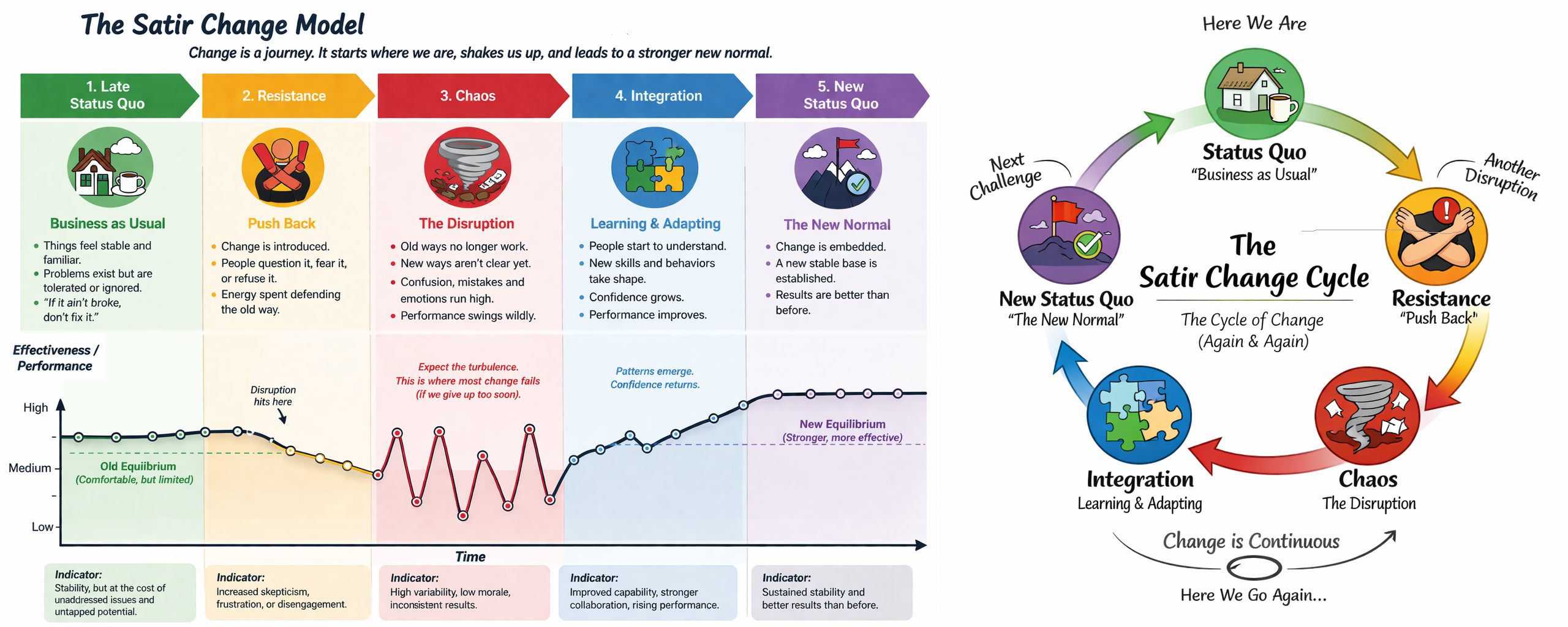
Virginia Satir developed her model of change while working in family therapy. It was later extended by Gerald Weinberg and others into organisational settings, where it turned out to describe the same dynamics with uncomfortable accuracy. The model tracks what happens to performance and emotional state as people move through change. It is not a project plan. It is a map of human behaviour under disruption.
The five stages
The model identifies five stages. They do not always arrive in the same order, and people within the same organisation rarely progress through them in sync. But the overall shape is consistent enough to be useful.
Late status quo is the starting point. Things are familiar, if not especially good. Problems exist but are tolerated, worked around, or quietly ignored. Performance is stable in the sense that people know what to expect. The absence of urgency is its own kind of problem: nothing burning means nothing changing.
Resistance follows when something disrupts the familiar pattern. This might be a new tool, a reorganisation, a policy change, or an external incident that can no longer be absorbed quietly. People push back, sometimes loudly and sometimes through the passive means of simply not engaging. Performance may dip slightly as attention shifts to managing the disruption rather than doing the work.
Satir’s point about resistance is important: it is not sabotage. It is the predictable response of a system trying to maintain stability. The resistance is also information about what the system values, what people fear losing, and what the change has so far failed to make safe.
Chaos follows when the old ways stop working and the new ways are not yet understood. This is the hardest phase. Performance drops, confusion rises, and people are operating without the habits and patterns they used to rely on. Emotions run high. Mistakes increase. There is a strong temptation to conclude that the change itself is the problem and to restore what existed before.
Integration is where things begin to turn. People start to understand the new way of working. Skills develop. Confidence returns in pieces. Performance recovers, though unevenly: some individuals and teams make the shift faster than others. The change begins to feel less like an imposition and more like the new normal.
New status quo is the destination, though it is also a temporary resting point. The new way has become habitual. Performance often settles higher than the original baseline, because the change that caused all the disruption was presumably an improvement. Until the next disruption arrives. Because it will.
The dip is not a malfunction
The most important thing the model communicates is that the performance dip during chaos is not evidence that the change was wrong. It is evidence that the change is real.
Changes that produce no dip are usually not changes. They are rebranding exercises, reorganisations that leave the actual work untouched, or training programmes that add knowledge without altering behaviour. Real change disrupts real things, and disruption costs something before it pays.
Organisations that understand this can plan for the dip. They can communicate that the drop in performance is expected and temporary, rather than allowing it to be treated as proof of failure. They can provide support during the hardest phase rather than demanding results during the period when results are least available. They can hold the shape of the change when the pressure to retreat is greatest.
Organisations that do not understand this tend to interpret the chaos phase as confirmation that the change should be abandoned. They retreat to the old status quo and conclude that their people are resistant to change, rather than recognising that the timing and support for the transition were insufficient.
Resistance as a map
Satir’s treatment of resistance carries a specific implication for how to work with people during a change. Resistance is not noise to be managed. It is a signal about the system.
When people say the change is over-engineered, they may be right about the specific implementation even if they are wrong about the direction. When people say it was faster before, they are describing a real experience of friction even if the friction is temporary. When people say they tried this in 2007, they are describing a trust deficit that the current change will have to earn its way through.
Reading the resistance correctly is more useful than overcoming it. The map shows where support is needed, where the design needs adjustment, and where the communication has left people without the context they need to commit.
Last updated: 1 July 2026