Backward planning with obstacle avoidance

Work backwards from your goals to surface dependencies, anticipate obstacles, and design smarter steps: always face-to-face, collaboratively, and with what most frameworks miss.

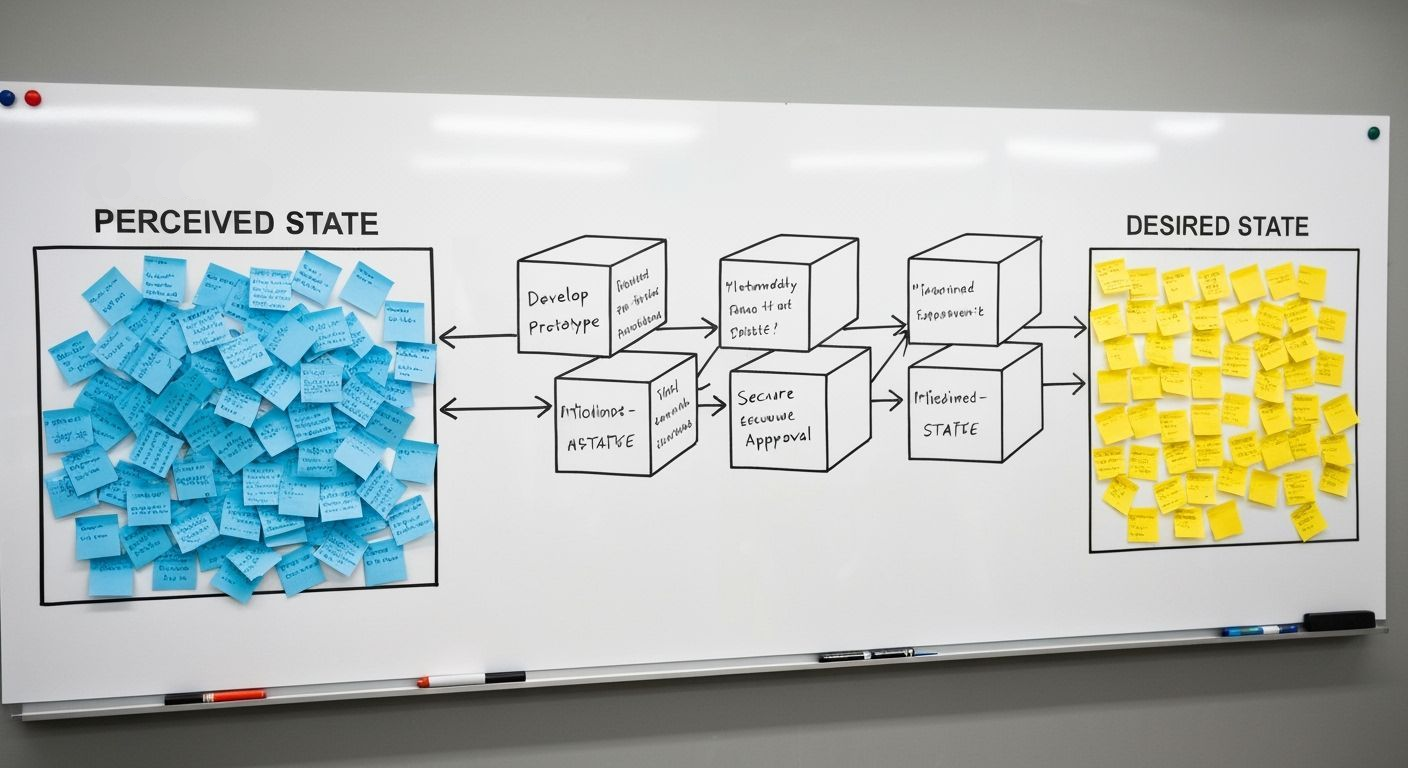
A wall-sized whiteboard displaying a backward planning process diagram. On the left, a box labelled "Currently Perceived State" is filled with chaotically placed blue sticky notes. On the right, a box labelled "Desired State" is filled with more orderly yellow sticky notes.

Backward planning starts with the desired end state and works in reverse. This reveals hidden dependencies, potential blockers, and early opportunities for contingency before they become problems. The process incorporates what most planning methods ignore: energy, timing, and blind spots, ensuring plans are grounded in how the work actually happens rather than how it is imagined to happen.

The Weinberg connection here is direct. The currently perceived state is a model. The desired state is another model. Working backwards between them surfaces the assumptions embedded in both: what do we believe is true now, what do we believe success looks like, and what conditions are we assuming will hold along the way? Those assumptions are the first things to test.

The flow

  1. Define the states: describe the currently perceived state honestly and clarify what success looks like and how you would recognise it when you reach it.

  2. Identify milestones and dependencies: map what must come before each milestone and who or what it relies on.

  3. Surface obstacles: anticipate risks, blockers, and challenges along the path. Include the human ones: whose buy-in is needed, where energy will be low, where resistance is likely.

  4. Develop contingencies: design flexible responses to each obstacle rather than a single fixed plan.

  5. Step forward: translate the backward map into practical, forward-acting steps with owners and timelines.

  6. Review and adapt: continuously monitor progress, reassess the assumptions embedded in the plan, and adjust actions when the model diverges from reality.

Each step produces usable insight on its own. Together they create a planning practice that accounts for the system rather than just the task.

What “obstacle avoidance” means

Obstacle avoidance in this process is not about eliminating obstacles. Many cannot be eliminated. It is about naming them before they appear so that the team has thought through a response and is not improvising under pressure.

The human obstacles are the ones most often omitted from plans and most often responsible for derailment. Who will resist this change and why? Whose co-operation is required but not yet secured? Where will the team’s energy be lowest and what does the plan ask of people at that moment? These questions belong in the planning process, not in the post-mortem.