Threat landscape
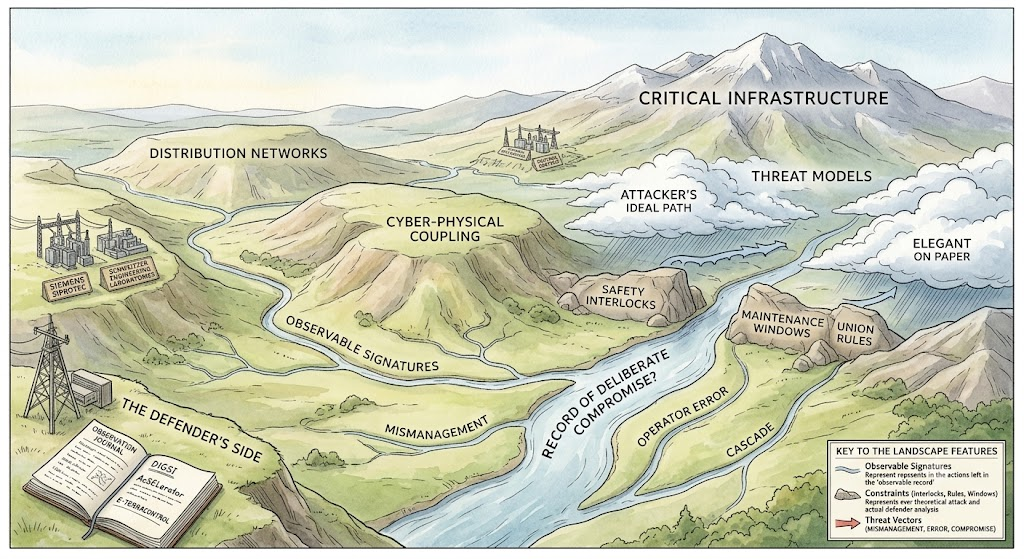
Reading threats to critical infrastructure at distribution scale from the defender’s side: not what an attacker would set out to do, but what those actions leave in the observable record, and what a defender can look for.
Threat models for distribution networks account for scale, cyber-physical coupling, regulatory constraints, and the gap between what an attacker might theoretically do and what they can actually do given organisational reality. A threat that looks elegant on paper may be impossible in practice because the configuration that enables it violates a safety interlock, or the maintenance window it requires doesn’t exist, or the operator has a union rule against that kind of simultaneous work.
So the through-line is not the catalogue of what could happen but the harder question underneath it: given a record, what tells deliberate compromise apart from mismanagement, operator error, or a cascade that simply ran its course?
Throughout, the protection-relay estate is taken as Siemens SIPROTEC and Schweitzer Engineering Laboratories, inferred from engineering-tool usage (DIGSI and AcSELerator) rather than independently confirmed by a procurement or vendor source. The historian is e-terracontrol’s own SQL Server historian.