Threat actors and capabilities
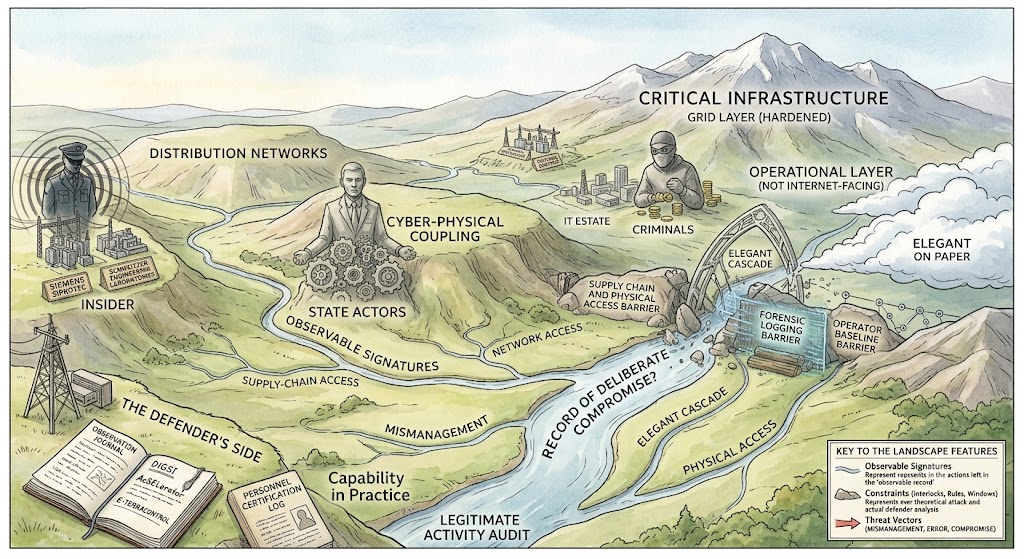
State actors have the patience for supply-chain and persistence plays, degrading service on demand or quietly learning how the network behaves at scale; criminals go where the money is, ransoming the IT layer or defrauding the metering estate rather than attacking the grid directly; and insiders trade on concentrated access, dressing an unauthorised act as legitimate maintenance.
A recurring conclusion is that capability on paper is not capability in practice. The elegant coordinated cascade, disable protection, corrupt the model, drive devices into unsafe states, runs into three hard constraints: the operational layer is not internet-facing, so reaching it needs supply-chain, network or physical access; it is instrumented for forensics, so legitimate-interface use is logged while bypassing the interface needs physical or supply-chain compromise; and the operator knows what the baseline should look like, so divergence surfaces and a cascade takes seconds to minutes rather than an instant.
What survives those constraints is not an attack on the equipment but on the processes that manage it: the engineering workstations, the network model, the certification of who may work. Such an attack exploits legitimate activity that is hard to audit continuously. A thinning, contractor-heavy workforce concentrates access to those systems in fewer hands and extends the exposure into the supply chain.