Attack surfaces
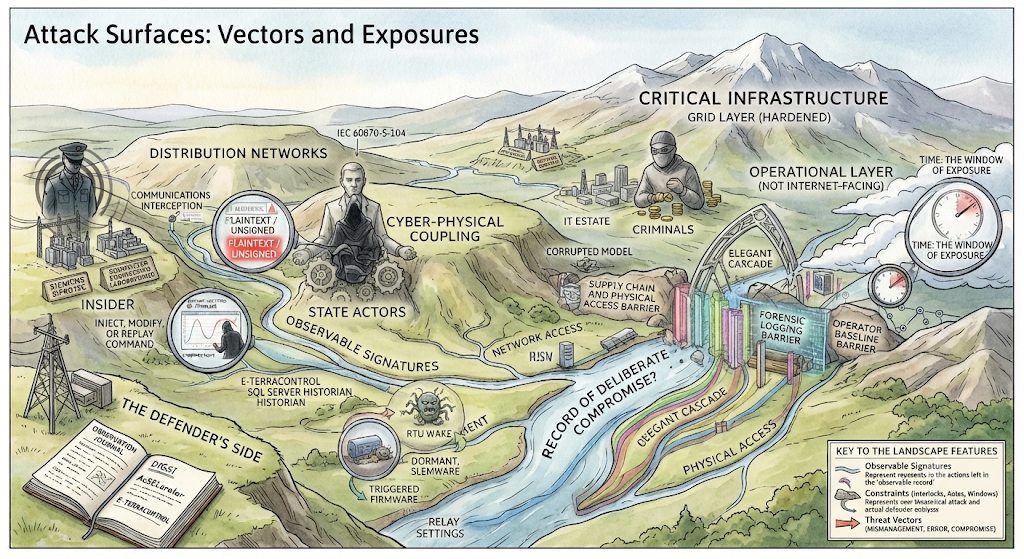
Two findings.
The telecontrol protocols and field devices were built for a trusted perimeter, not message-level authentication: IEC 60870-5-104 carries commands in plaintext and unsigned, so an attacker with network access can inject, modify or replay a switching command, or spoof the state that comes back. The most dangerous variants corrupt the operator’s picture rather than a single device, a false state report that has the control room acting on a network that is not there, or dormant firmware in an RTU that behaves normally until a trigger pattern wakes it.
The second finding is what limits all of it. Every layer, relay settings, SCADA configuration, the Smallworld model, RTU firmware, the historian, is held against a stored baseline, so a single-sided change is in principle flagged by online-versus-offline comparison and a later update from the engineering tool re-imposes the baseline. To stay hidden an attacker has to corrupt both the live device and its baseline at once, or spoof consistently across independent records.
What is left as the standing exposure is time: the interval between baseline checks is the window in which a two-sided change sits undetected, and the shorter that interval, the smaller the gap an attacker has to hide in.