Observable signatures
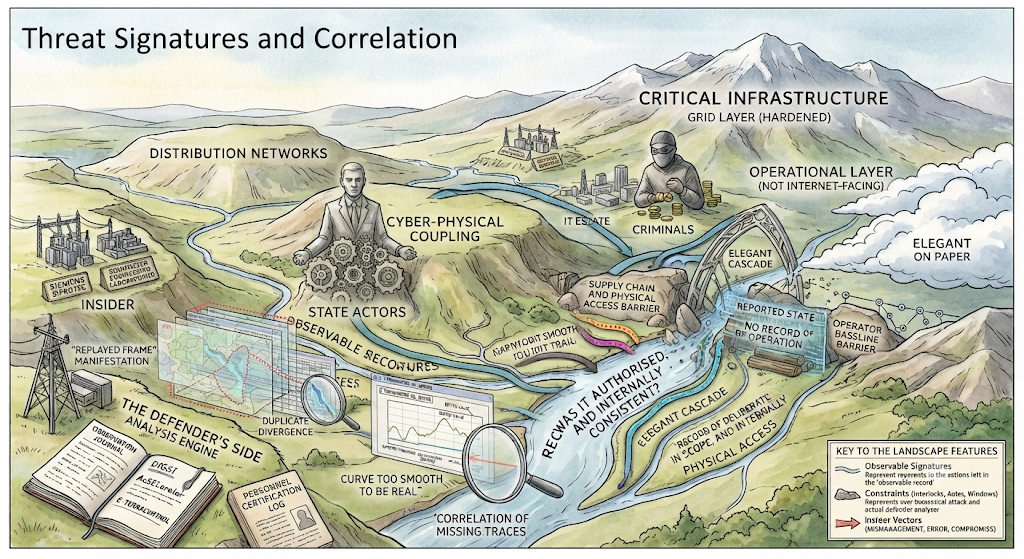
Each threat type leaves its own mark, a replayed frame as duplicate RTU commands, a raised relay threshold as baseline divergence, an edited historian value as a gap in the audit trail or a curve too smooth to be real, an impersonated operator as an off-shift login or two simultaneous sessions, window abuse as a work order that does not match what changed.
Whatever the threat, its signature reduces to one shape: a divergence between two records that ought to agree, the control-room command log against the RTU’s received-command log, the relay’s own event log against the historian, the reported state against the physically measured one. No one system is trusted to check itself. What the shape alone does not settle is whether a given divergence is worth anything, and that turns on two things: where the corroborating record sits, and what to make of a record that is simply not there.
Records beyond the actor’s reach
A divergence is only as good as its second record. The decisive one is the record the actor under suspicion could not have rewritten as part of the act: the packet capture independent of the system’s own logs, the as-found-and-as-left report, the physical measurement, the audit trail the historian does not control. Where both disagreeing records lie within the actor’s reach, the divergence proves little, because a competent actor edits both to agree. So the real question behind every signature is not just whether two records diverge, but whether the corroborating one is independent of the party being investigated. A signature resting on a single record the suspect could forge is a weak one, however clear it looks, and the same estate can hold a determination robustly against an outside attacker while being unable to make it against an insider with write access to the record.
Absence as evidence
The hardest signature is the one that is not there. A replay on IEC 60870-5-104 can execute without an obvious log, and an actor can clean the audit trails behind the act, so the absence of an expected trace becomes the evidence, a relay known to have operated with no record of the operation, maintenance with no connection log, a window with no switching record. Absence is at once the weakest evidence and, in quantity, among the strongest. Weakest, because a missing record is at least as likely to be ordinary malfunction, a failure to log rather than a deletion, so a single gap proves almost nothing and a false-positive floor is built in. Strongest, because coherent removal is expensive: to erase an act cleanly an actor has to find and delete every trace of it across systems built to record independently, and a pattern of absence, several missing logs where operations certainly happened, is far harder to pass off as accident than any single gap.
No signature stands alone. A divergence counts only against an independent second record, and an absence counts only as a pattern across systems built to record apart. The mark of an attack is not any single trace but the shape of the record around it, what agrees, what does not, and what is missing where it should not be.