Chasing the hinge
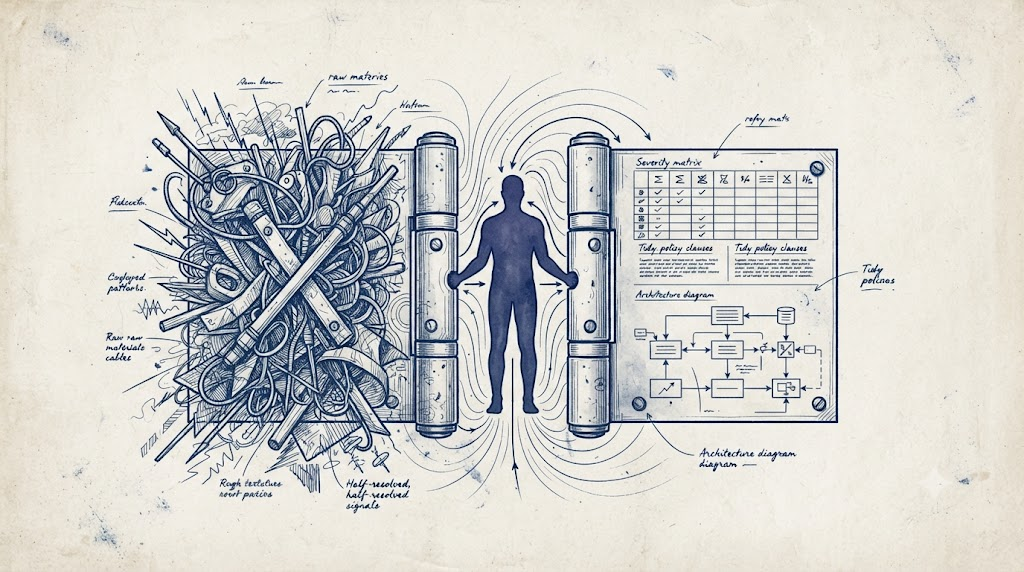
A control gets written so that the outcome follows from the wording. A severity matrix decides what an alert is worth, a policy leaves no judgement to exercise, an architecture diagram fixes how the behaviour will go. A system that works regardless of who runs it needs nobody to be trusted.
It never quite arrives. The matrix needs somebody to decide which field it reads, the policy needs somebody to say what counts as an exception, and the diagram is a claim about the estate made by whoever drew it. Route around the person at one point and the requirement turns up at another.
Somebody stands between what gets encountered and the account made of it. That position is the hinge, the joint both sides turn on, and it is no wider than its occupant can tell things apart.
Lewin’s field theory says why the position is person-shaped: behaviour is a joint function of the person and the situation as that person reads it, so a model never gets read off a system. Ashby’s variety gives the width a size, and the count depends on who is doing the distinguishing.
What stocks a position that size is mostly borrowed. Few distinctions get worked out from scratch, and the ones picked up arrive with a vocabulary attached. Not all of it survives the journey. What the occupant can do with any of it depends on the posture they are holding when the situation declines to fit.
Keeping a person in the joint, and stocking the position well:
Last updated: 9 August 2026