Book review: To educate the human potential
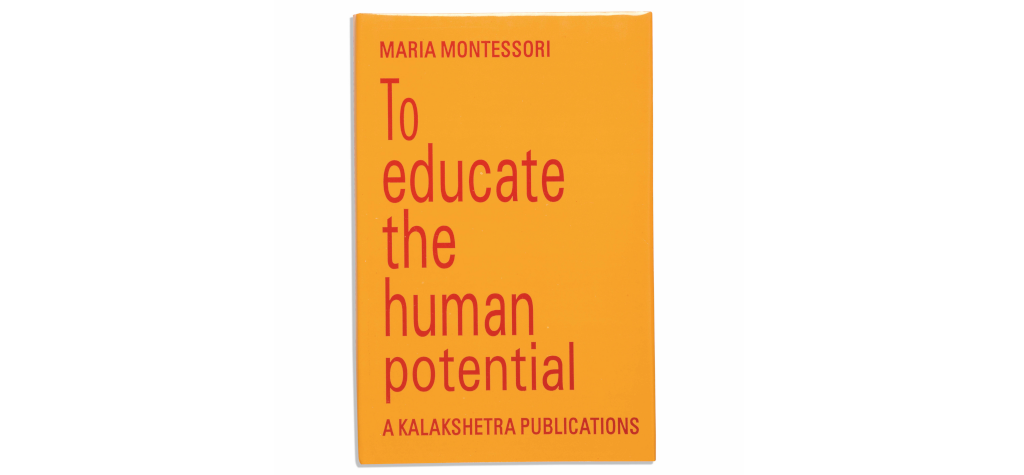
“To Educate the Human Potential” (1948) is a curriculum delivered as a story. It sets out Montessori’s cosmic education for the six-to-twelve child: begin with the whole, the forming of the universe, the arrival of life, the long human effort behind writing and number, and let the particulars find their place inside that frame afterwards. The device is the great lesson, a deliberately grand narrative told to fire the imagination, on the theory that a mind given the big picture goes looking for the details rather than waiting to be handed them. It is the most romantic of her books, and the one whose central idea maps least obviously and most usefully onto security.
The whole before the part
Cosmic education inverts the usual order. Instead of accumulating facts toward an eventual overview, the learner is given the overview first and reads the facts as belonging to it. A security curriculum built the other way, tool after tool, control after control, produces people who can drive a scanner without a picture of what they are defending or against whom. Handing over the whole first, the shape of the estate, the adversary’s economics, the way an intrusion actually travels, gives every later skill somewhere to attach. The instinct is close kin to the systems view: a part is only legible inside the whole it belongs to.
Imagination as an instrument
Montessori treats imagination as a working faculty, not a decoration: the elementary child cannot visit the Cambrian sea or the first scribes, so imagination is how they reach what the senses cannot. Security has more of this than it admits. Nobody watches a full intrusion end to end; the analyst assembles it from fragments and imagines the adversary’s next move, and threat modelling is disciplined imagination about attacks that have not happened. The book’s contribution is to treat that faculty as trainable and central rather than as a knack some people happen to have, a more serious claim than the gamified surface of most security education gets near.
The romance of the whole
The register is the risk. Montessori’s great lessons run on wonder, and wonder is a hard thing to manufacture on a Tuesday for a team that came in to close tickets. The narrative sweep that lights up a nine-year-old can read as grandiosity to adults who have learned to distrust a big story, and cosmic education in the wrong hands becomes a fortnight of context-setting that never reaches a skill. The book also assumes a guide who can tell the story well, which is rarer than the method lets on. Stripped of the romance, the ordering principle holds: the whole first, because a detail without its frame is inert. The enchantment does not travel. For adults the frame mostly earns its place by being useful, and a review that promises wonder is writing a cheque the Tuesday will bounce.
Last updated: 15 July 2026