Book review: More secrets of consulting
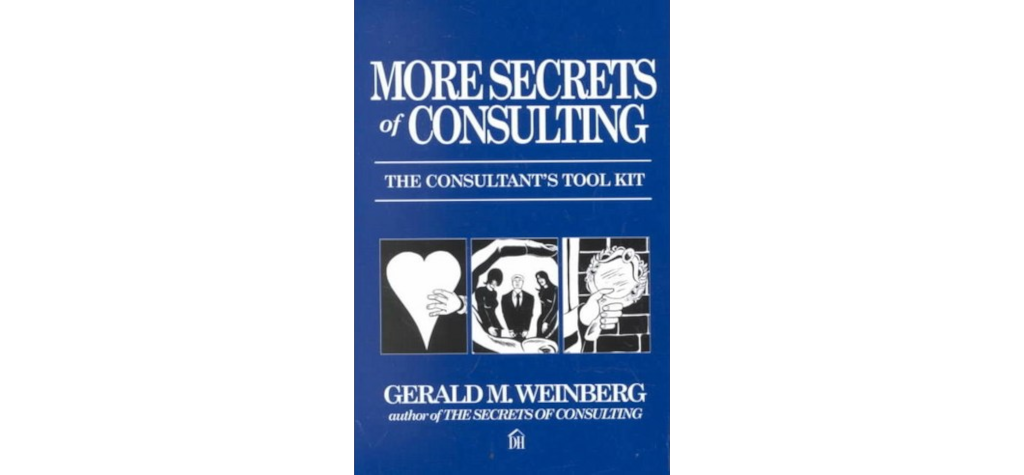
Weinberg’s “More Secrets of Consulting: The Consultant’s Tool Kit” (2002) is the sequel that turns inward. The first book catalogued laws about clients and advice; this one is built around a set of imagined tools the consultant carries, among them the Wisdom Box, the Golden Key, the Courage Stick, the Yes/No Medallion and the Oxygen Mask, each a chapter and each a metaphor for an internal capacity rather than a technique. The premise, stated without much ceremony, is that the instrument doing the consulting is the consultant. A miscalibrated instrument produces bad readings no method can correct. That premise is Virginia Satir’s, and the book wears the lineage openly, which is why it reads as her work continued rather than as more of the first.
The instrument is the self
The tool underneath all the others is self-esteem, which Weinberg treats not as confidence but as the capacity to stay whole under pressure. It is the same ground as the core Satir observation that congruence, actions, words, feelings and context in alignment, is what holds communication together when stress pulls at it. A consultant whose sense of worth depends on being right will placate, blame, or retreat into procedure the moment a client pushes back, and will do it without noticing. Most of the tools are devices for catching that slippage early. The Mirror asks what the consultant is contributing to the problem they were brought in to fix. The Oxygen Mask restates the airline rule: someone running on empty helps no one, so tending one’s own state reads as a precondition for the work rather than an indulgence.
Tools for the survival stances
Set against the survival stances, the kit works as a field manual for staying congruent when threat pulls the other way. The Yes/No Medallion is aimed at the placating reflex: a consultant who cannot say no cannot be trusted when they say yes, because the yes was never free to begin with. The Courage Stick is for the moment when the honest observation is the unwelcome one and the room would rather it stayed unsaid. The Fish-Eye Lens widens the frame when blame has narrowed everyone’s attention onto a single culprit. None of them are clever, and Weinberg does not claim they are. Their use is that they name the internal move at the point of pressure, which is exactly where it is hardest to see and easiest to make.
Congruence under threat, as a daily condition
Security work supplies the pressure the book is written for. Incident calls, audit findings, the meeting where a slipped fix has to be explained: these are the situations Satir describes, and the ones where placating, blaming and computing quietly take the controls. A blameless post-incident review is congruence built into a procedure. An analyst who can name a missed detection without either self-flagellation or deflection is running something close to the Mirror. The contribution is to treat these as trainable internal moves rather than temperament that some people are lucky enough to have.
What it leaves out
The whimsy runs heavier than in the first book, and anyone allergic to the tool-as-talisman device will find it wears quickly. The tools blur into one another; several are one observation in a fresh costume, and the psychological claims arrive as workshop lore rather than anything tested. It is also resolutely individual. It equips a person, not a team, and has little to say about an organisation that punishes the very congruence it recommends, which is often where the real damage sits. What it does hold onto, more steadily than most of the field, is that the person on the incident bridge is themselves a part of the system, and a part that can be tuned. When the bridge turns ugly and everyone reaches for a stance, that is the tool actually in play, whatever the runbook says.
Last updated: 15 July 2026