Regulatory and governance
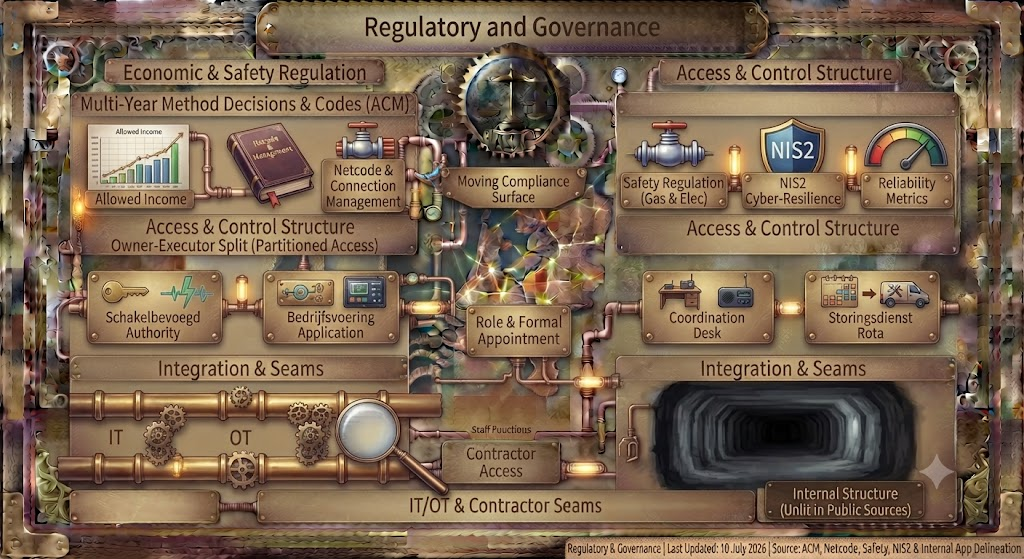
Stedin’s regulatory perimeter is a moving target, spread across several supervisors: the ACM for economic regulation, SodM for gas safety, the RDI for cyber and metering, ILT for high-pressure gas. The governing law shifted onto the Energiewet on 1 January 2026, still bedding in, which leaves gas safety the least-settled corner. Two market duties bite hardest. The connection obligation is close to absolute, and Stedin has been found in breach for refusing one; transport is conditional on first examining whether congestion management could reconcile available and requested capacity. Reliability runs through the biennial investment plan, minimum quality norms and the q-factor incentive, and the compensation and tariff figures are perishable while the durable material is the mechanism.
The governance side reads as access control written in company law. Unbundling forces the regulated network into a separate entity, yet access deliberately crosses those boundaries at visible seams: the shared estate left by the Enduris merger, DNWG Infra holding operational and metering access to third-party regulated networks, and the Utility Connect and TensZ joint ventures that put grid data and assets into jointly-controlled hands. Ownership is public-only, with the State taking around 12 per cent in 2023. What the public record fixes is entitlement, which entity may reach which asset; what it does not reveal is enforcement, the internal role model, the IT-versus-OT segmentation and the identity infrastructure that turn entitlement into live permission.