Organisational structure
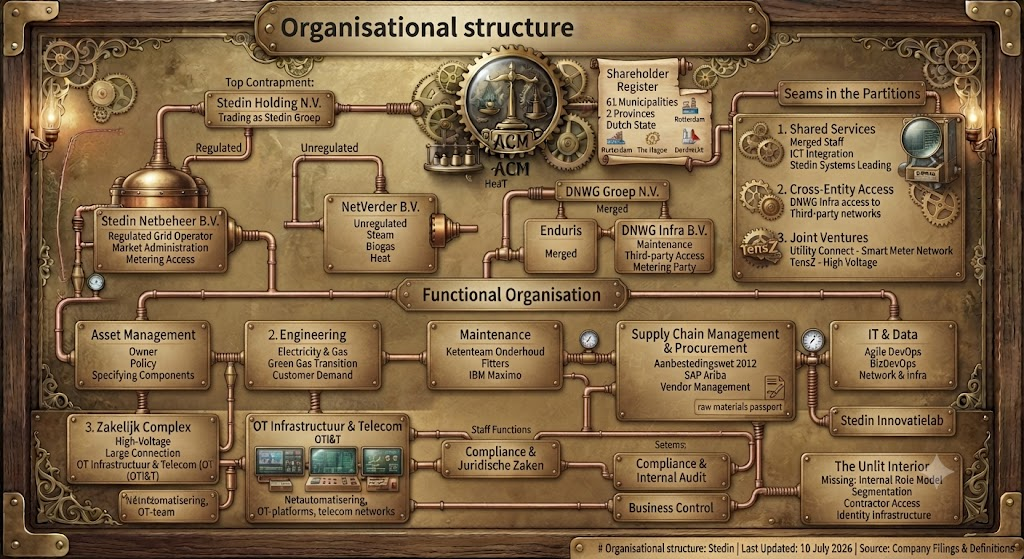
Corporate partition
At the top sits Stedin Holding N.V., trading as Stedin Groep, with three separate subsidiaries: the regulated grid operator Stedin Netbeheer B.V., plus the unregulated NetVerder B.V. and DNWG Groep N.V. DNWG Groep in turn holds the infrastructure company DNWG Infra B.V.
The group’s own definitions treat these as distinct legal persons. This separation is not cosmetic. It descends from the Wet Onafhankelijk Netbeheer, of 2006, which requires utilities to hive the regulated network activity into a separate company under a group prohibition; upheld by the Hoge Raad in 2015, it is why Stedin was split from Eneco in the 2017 demerger.
In access terms, the group prohibition is an access control regime expressed through company law. It dictates which legal entity may operate the regulated gas and electricity networks and separates the regulated network operator from commercial activities. Dutch law also requires regulated gas and electricity network activities to be kept separate from other energy infrastructures such as steam, biogas, CO₂ and heat. Stedin therefore transferred those activities into the separate NetVerder brand in 2019.
The access-and-confidentiality regime
As network operator, Stedin runs the market administration and is obliged to keep its networks accessible to every energy supplier on equal terms, which pins non-discrimination and data confidentiality onto the same boundary.
The division of labour over metering data is instructive: an earlier ACM dispute decision established that under the Informatiecode it is the supplier that collects meter readings for billing, while the operator measures on the supplier’s behalf rather than for the consumer directly. The entitlement to customer consumption data is split by role, not held wholly by the operator.
Under the Energiewet this hardens further through the new data-exchange entity that mediates energy data between operators, suppliers and end users, and through the metering and data-security supervision the RDI picks up.
Seams in the partitions
Access deliberately crosses the boundaries the unbundling regime draws. Three crossings show up in public filings.
The first is shared services. When Enduris was folded into Stedin from 1 January 2022, the Zeeland network operator took the Stedin name and more than 600 staff moved across, merging two operators’ staff functions and grid operations under one name. That is a single operational and system estate spanning what were two operators.
The second is DNWG Infra, which performs maintenance and management on networks entrusted to it by other operators, naming Evides Waterbedrijf, Stedin and TenneT, and acts as a recognised metering-responsible party. An unregulated group subsidiary holding operational and metering access to third-party regulated networks is a notable cross-entity entitlement.
The third is the joint ventures. Utility Connect B.V., a JV with Alliander’s network group, runs its own wireless telecommunications network to read smart-meter data and communicate with smart-grid applications, a shared metering-data channel co-owned with a different DSO group. TensZ B.V. is the fifty-fifty vehicle with TenneT for managing high-voltage networks. Both put operational access to grid assets and data into entities jointly controlled with outside parties.
Decision rights
Above the operating layer, control is exercised through a two-tier board, a raad van bestuur running the group and answerable to a raad van commissarissen.
Shareholder power is concentrated but capped: the Energiewet’s predecessor required public-only ownership, so the register is 61 municipalities, two provinces and the Dutch State, the State having taken 11.8 to 11.9 per cent for 500 million euro in December 2023. The largest holders are Rotterdam, The Hague, the State and Dordrecht.
Day-to-day shareholder interaction runs through a twelve-member aandeelhouderscommissie representing all shareholders, with relations set out in the statutes and a shareholder covenant. This is who can direct the entity, as distinct from who can operate its systems.
Functional organisation
Business units
The operating organisation is described less as product divisions than as a set of “ketens” (chains) and business lines. Stedin’s careers pages list Asset Management as the owner function, Engineering split into electricity and gas, a Zakelijk Complex chain holding the high-voltage and large-connection work, Supply Chain Management, and IT & Data. Above these, at group level, the regulated operator Stedin Netbeheer sits alongside NetVerder and DNWG. Staff functions visible in the same material include Compliance & Juridische Zaken, Internal Audit and Business Control.
OT versus IT separation
Stedin frames IT and OT as a single risk domain rather than two separate worlds. A KPN write-up of a Stedin conference talk describes one security operations centre monitoring both, strict network segmentation, access rights held to a minimum, and critical systems able to run in island mode cut off from external connections.
Structurally, though, OT lives in its own vakgroep OT Infrastructuur & Telecom, OTI&T, which places it inside the Zakelijk Complex chain and lists teams for Netautomatisering, OT-platforms and telecom networks. The OT estate itself is described as applications, services, OT platforms, a telecom network and “IT for OT”. IT proper is a separate agile organisation with 35 DevOps teams moving to BizDevOps, plus a Netwerk & Infra function.
The public story is convergence at the risk and monitoring layer over a real organisational and network split beneath it.
Network operations centre
The Bedrijfsvoeringscentrum is described as the beating heart of the operator, where the electricity and gas networks are watched in real time on large screens, with operational specialists using those feeds to look ahead and head off overload through flexible capacity and congestion measures. High-voltage management and maintenance is run jointly with TenneT through the TensZ joint venture, so that slice of operations is shared rather than wholly internal.
Asset management
Asset Management reads as the owner function rather than an execution one. A Business Control vacancy has it acting as the asset manager that commissions other departments to realise infrastructure works and projects, and developing the policy through which the targets are met.
Its own careers material describes specifying components and setting long-horizon policy, some of it reaching decades ahead, staffed by strategic and tactical asset managers, net specialists and fault specialists. It is the function that decides what gets built and maintained, and hands the doing to others.
Maintenance
Maintenance runs through a Ketenteam Onderhoud. A Gemba vendor case study describes around 300 fitters keeping the gas and electricity installations in condition, working in IBM Maximo, and moving from static supplier-defined intervals to risk-based maintenance with Gemba consultants embedded in the chain team. The chain covers low-voltage, medium-voltage and gas, with high-voltage being folded in, and the work is commissioned by Asset Management, consistent with the owner-executor division.
Engineering
Engineering is presented as the bridge from customer demand to net calculations, advice and design, split into electricity and gas engineering, with a separate Engineering Gas line reflecting the hydrogen and green-gas transition. It sits between the technical estate and the customer-facing plans.
Cybersecurity
The security function is anchored in a central CISO within a CIO/CISO office. OT security specialists sit in a team of about twelve inside OTI&T, operationalising a central Stedin cybersecurity policy, working to IEC 62443 and ISO 27001, reviewing configurations and logs, hardening, guiding pentests and applying security by design, with work located partly at high-voltage stations and datacentres.
Supplier risk is assessed, contractually fixed and technically tested, with the stated view that certification alone is not enough and products are tested before they go into the network.
Personnel screening is heavy, with a VOG and full screening required before starting and self-employed contractors excluded from these roles.
Procurement
As a contracting authority Stedin is bound by the Aanbestedingswet 2012 and publishes European tenders through TenderNed, running procurement and supplier management on SAP Ariba, with a Vendor Management function setting per-tender KPIs and a raw-materials passport tracking component circularity.
External hiring runs through a separate Dynamisch Aankoopsysteem and a Stedin Inleensysteem.
Two governance threads run through procurement: the governance code Veilige Energienetten extended to chain partners, and OECD-based human-rights and environmental due diligence across the supply chain.
Architecture
Architecture appears as a layered function: enterprise architects and solution architects at the centre, with OT domain architects who align the network and platform structures for OT with those enterprise and solution architects. Within OTI&T there is a dedicated Security & Architectuur team, so security and architecture are treated as one grouping on the OT side rather than kept apart.
Innovation groups
The visible innovation work centres on algorithms and AI built into the networks. Stedin has described geographic AI models, trained on data going back to 2013, that estimate both the failure probability of an infrastructure component and the impact of a fault, combining location data, satellite imagery and subsurface data into a risk model that steers maintenance and replacement toward incidents before they happen. The delivery model is DevOps and BizDevOps, with collaborations alongside startups, universities and market parties. Embedding decision logic in the nets carries its own exposure: a design fault in an algorithm that plans or steers the network could propagate, which places this work on the same risk boundary as the OT estate it informs.
The unlit interior
Public sources fix the legal boundaries, the regulatory access separation, the shared-service and JV crossings, and the governance chain, and they describe which functions exist and roughly how they hand work to each other. What they do not reveal is the internal role model, the segmentation between IT and OT, the contractor and supplier access arrangements, or the identity infrastructure that turns those entitlements into live permissions. The corporate map tells which entities are entitled to reach which assets; it does not tell how tightly that entitlement is enforced, which is the gap between an org chart and an access-control finding.
Last updated: 11 July 2026