Regulatory perimeter
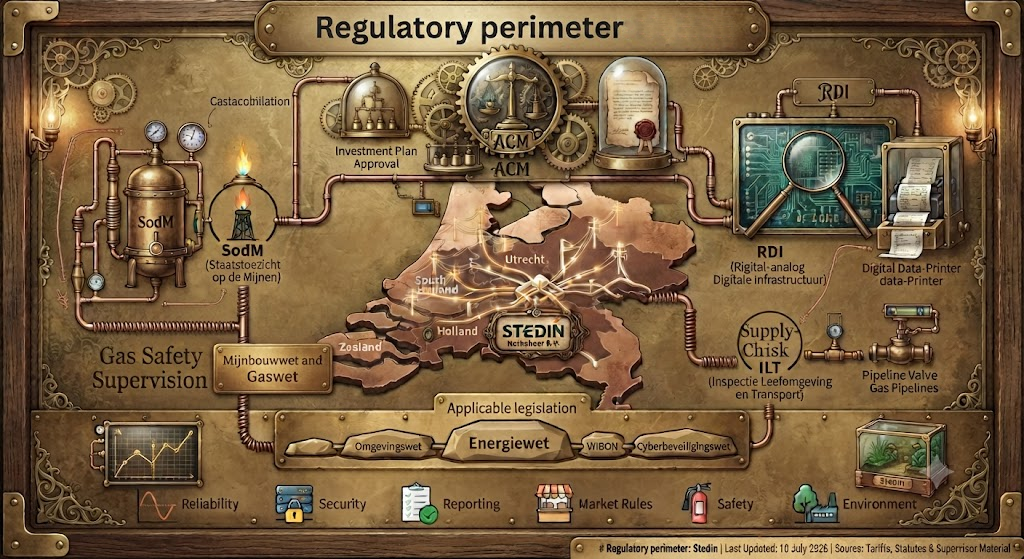
Stedin Netbeheer B.V. is one of the six regional distribution system operators in the Netherlands, running electricity and gas distribution across most of South Holland, Utrecht and parts of Zeeland, and owned by municipalities and provinces in its area.
Its perimeter sits across several supervisors and a body of law that shifted on 1 January 2026, when the Energiewet took over from the Elektriciteitswet 1998 and the Gaswet. That transition is still bedding in, so parts of this mapping, gas safety in particular, remain provisional.
Regulators
The economic regulator is the Autoriteit Consument en Markt (ACM). Because a regional operator holds a monopoly and customers cannot choose their operator, the ACM as supervisor fixes the maximum tariffs an operator may apply. Beyond tariffs, it sets the codes, approves investment plans, resolves disputes between users and the operator, and supervises quality indicators.
Gas safety supervision falls to Staatstoezicht op de Mijnen (SodM), which oversees the regional network operators and private owners of small gas networks, with the emphasis on the safety of the network, the meter and the gas; its statutory footing has been the Mijnbouwwet and the Gaswet.
Digital resilience, metering and data security sit with the Rijksinspectie Digitale Infrastructuur (RDI), which currently supervises the energy sector under the Wbni and gains a broader role under the Energiewet over metering, cyber risk and data security.
For high-pressure gas transport, an earlier division of labour placed the Inspectie Leefomgeving en Transport (ILT) as competent authority for pipelines at 16 bar and above, with SodM and ACM alongside. The Minister for Klimaat en Groene Groei designates system operators and makes policy, and for cyber incidents the national CSIRT function runs through the NCSC.
Applicable legislation
The anchor is the Energiewet, in force from 1 January 2026, which merges and replaces the Electricity Act 1998 and the Gas Act and transposes the EU Clean Energy Package. It is filled in by the Energiebesluit and by ACM-set codes (the Netcode, Tarievencode and Informatiecode), which carry the operational detail and now speak of transmission and distribution system operators rather than netbeheerders.
On the security side, the Cyberbeveiligingswet transposes NIS2 and replaces the Wet beveiliging netwerk- en informatiesystemen (Wbni), with entry into force aimed at the second quarter of 2026 alongside the Wet weerbaarheid kritieke entiteiten.
Physical and spatial legislation runs through the Omgevingswet (pdf) and its decrees, excavation-damage prevention through the WIBON, and the Mijnbouwwet remains relevant to SodM’s mandate. Above these sit the EU electricity and gas directives, the network code on cybersecurity (Regulation (EU) 2024/1366), and REMIT on market integrity, breach of which the Energiewet can treat as a criminal offence.
Reliability obligations
The core instrument is the biennial investment plan. Under article 3.34 of the Energiewet, system operators draw up an investment plan every two years setting out the investments they judge necessary for their statutory tasks, which the ACM assesses for reasonableness.
Alongside this, the rules impose minimum quality norms and the obligation to maintain a quality assurance system, and the ACM supervises indicators including reliability, safety and product quality. A functioning asset register underpins this: an older enforcement action turned on Stedin lacking a current and complete bedrijfsmiddelenregister, the basis for the quality management system through which an operator can detect risks to network quality in time. Reliability also carries a financial edge through the q-factor incentive, and a compensation scheme the ACM oversees.
As a mechanism rather than a durable figure: no compensation applies below four hours, with a set amount for a four-to-eight-hour interruption and an increment for each further four-hour block, framed explicitly as an inconvenience allowance rather than damages.
Security obligations
Under the NIS2 regime the two load-bearing duties are a duty of care and a duty to notify.
The duty of care requires appropriate and proportionate technical and organisational measures to manage cyber risks, with standards such as ISO 27001 encouraged rather than mandated.
Supply-chain risk is now explicit: the RDI has signalled that, for the energy sector in 2026, problems at a single supplier can propagate into vital energy processes, so mapping those interdependencies is part of the expected posture. That same guidance places the sector-specific Netcode on Cybersecurity and parts of the Energiewet alongside the Cyberbeveiligingswet and the Wet weerbaarheid kritieke entiteiten, with board-level accountability a distinguishing feature of the regime.
Reporting requirements
Reporting clusters in three places.
Investment plans and tariff proposals, and quality plans, with interruptions and deviations in transport detailed in the Besluit investeringsplan en kwaliteit elektriciteit en gas (pdf) go to the ACM.
Once the Cyberbeveiligingswet is in force, significant incidents are notified to both the competent supervisor and the CSIRT, on a cadence of an early notification, a fuller report and a final report (commonly rendered as 24 hours, 72 hours and one month).
Gas safety incidents go to SodM. Excavation damage is registered and analysed by SodM in cooperation with the RDI, and the WIBON governs the location-data exchange that precedes digging.
Market rules
Market conduct is governed by the ACM codes and by the Energiewet’s connection and transport regime. The connection obligation is close to absolute: a dispute decision found Stedin in breach of article 23 of the old Elektriciteitswet for declining to offer a connection to a party with its own immovable property.
Transport is more conditional. Another decision established that where capacity is genuinely insufficient the operator is not obliged to offer transport, but is expected first to examine whether congestion management could reconcile available and requested capacity before refusing, and Stedin was found to have acted contrary to the Netcode by not doing so. The market layer also carries the tariff methodology set through successive ACM methodebesluiten, along with submarket and voltage-level definitions, unbundling, the new data-exchange entity the Energiewet introduces, energy-community provisions, and REMIT market-integrity rules.
Safety legislation
Gas safety is the least settled part of the map after the transition. The substantive duties are familiar: gas of the right composition, odorisation so leaks can be found, safe smart meters, and safe working on live pipes. SodM has enforced these directly against Stedin: after a 2022 explosion in Zoetermeer, it found that inadequate drawings and instructions meant Stedin had not sufficiently secured the preconditions to prevent the occurrence, and so did not meet article 8 of the Gaswet. The wrinkle is that the Gaswet was repealed on 1 January 2026, while SodM’s published materials still reference it, so the statutory anchor under the Energiewet framework remains to be confirmed against current SodM guidance rather than assumed.
The green-gas dimension is live: SodM has pressed operators on injection safety, noting they do not always work fully in line with the statutory requirements and at present monitor odorisation insufficiently, a concern that grows with the blending obligation from 1 January 2027. Worker safety on excavation runs through the Arbo framework.
Environmental obligations
These run mainly through the Omgevingswet (pdf) and its decrees, which replaced the older inrichting-based permitting with activity-based regulation, so that individual activities within the physical environment are separately regulated and can carry a notification or permit duty. External safety of pipelines carrying hazardous substances is handled through place-bound risk and group risk, the logic formerly in the Besluit externe veiligheid buisleidingen and now carried into the Omgevingswet system, with a quantitative risk analysis for qualifying new pipelines.
Excavation-damage prevention sits in the WIBON, whose aim is to prevent damage to underground cables and pipelines from digging, so that essential services are not disrupted and digging teams can work safely, elaborated through the CROW 500 guideline. A WIBON revision was in open consultation into 2026, including a proposal to bring overhead high-voltage transmission within scope, so this corner is moving too.
The 1 January 2026 handover means much secondary regulation and code revision is still catching up to the new act. The compensation and tariff figures are perishable; the durable material is the mechanism.
Last updated: 11 July 2026